Deutsche Bank2026-10-28 06:34:43Deutsche Bank says weaker demand for long-dated Treasuries may push shorter issuanceDeutsche Bank strategists said the U.S. Treasury’s request for primary dealers to comment on changes in investor demand and the future size of Treasury auctions points to softer demand for long-dated U.S. government debt. The bank said the move suggests the market is showing less appetite for longer-maturity Treasuries. With the Treasury facing larger funding needs, strategists added that the maturity profile of newly issued debt could shift shorter in the future. The remarks were cited by ChainCatcher in a brief market update.00
US midterm el2026-10-27 08:28:10DWS says Wall Street should focus on 10 market questions ahead of the 2026 U.S. midtermsWall Street may be watching which party wins Congress in the 2026 U.S. midterm elections, but DWS argues that is not the question that matters most for markets. In a report dated Oct. 26, the Deutsche Bank-owned asset manager said investors should focus on the gap between election outcomes and what markets have already priced in. That distinction, it said, often matters more than the political result itself. The report lays out 10 issues investors should track. They range from whether markets have already absorbed expectations for control of the House and Senate, to whether state and local elections could have a more direct effect on companies tied to power grids, land use and data center approvals. DWS also challenges the common view that divided government is automatically bullish for equities, saying legislative gridlock does not remove the risk of shutdowns, fiscal strain or policy shifts through executive action. The report also highlights AI infrastructure as a new political variable in this cycle. Local resistance tied to electricity prices, grid capacity and permitting could affect the cost and timing of data center projects. For bond investors, DWS says the key questions remain fiscal deficits, Treasury supply, inflation expectations and long-term yields. Its broader conclusion is straightforward: markets do not trade election labels, they trade changes in growth, inflation, earnings and rate expectations.30
BlackRock2026-10-27 08:24:28BlackRock bond CIO says high-grade AI infrastructure debt looks more attractive than long-dated TreasuriesRick Rieder, BlackRock’s global chief investment officer for fixed income, said in an interview with Bloomberg Television that debt tied to AI infrastructure financing now offers a more compelling setup than long-dated U.S. Treasuries. He said the scale of debt financing linked to AI buildout is unprecedented, with issuance supporting GPUs, data centers and other related infrastructure. According to Rieder, the expansion in corporate bond supply has improved yield terms for investors. While the yield on the U.S. 10-year Treasury has moved above 5%, he said investors can get roughly 7% from shorter-dated single-A corporate bonds while avoiding the duration risk that comes with long-term government debt. Rieder described the current market as a potential once-in-a-generation opportunity. He also said he prefers secured bonds issued by high-quality companies and assets that generate cash flow, and added that valuations in semiconductor and computing stocks still appear reasonable.80
BlackRock2026-10-27 08:24:17BlackRock bond CIO says AI infrastructure debt looks more attractive than long-dated TreasuriesBlackRock Global Fixed Income Chief Investment Officer Rick Rieder said debt issued to fund the buildout of artificial intelligence infrastructure has reached an unprecedented scale and now looks more attractive than long-dated U.S. Treasuries, according to Yonhap News. In an interview with Bloomberg Television, Rieder said the amount of financing flowing through both bond and equity markets is unlike anything he has seen, calling the current period the most attractive investment environment of his career. He said he is focused on high-quality bonds sold to finance GPUs, data centers and other AI infrastructure, adding that the size of new corporate bond issuance has improved rate terms for investors. Rieder said the U.S. 10-year Treasury yield has moved above 5%, but Treasuries have been pushed to the sidelines by other products and are now used more as a benchmark for equities. He added that investors can earn about 7% on short-dated single-A bonds while avoiding the duration risk tied to long-term government debt. The report also said global high-quality AI-related financing has topped $300 billion this year, roughly triple last year’s full-year total.60
Federal Reser2026-10-27 04:37:09Fed October hike odds fall from 64% to about 11% as markets shift focus to DecemberWith only days left before the Federal Reserve’s October policy meeting, rate expectations have swung sharply. Federal funds futures had priced roughly a 64% chance of a hike a month ago, but that probability has now dropped to about 11% to 12%, while the market assigns around an 88% chance to no change on Oct. 28. In a market note published on Oct. 26, Monkey Business author Eric Salzman argued that the move says more about financial market positioning than a clear deterioration in the U.S. economy. He pointed to inflation still running above the Fed’s 2% target, resilient consumer and business spending, and a labor market that remains relatively firm. The article links the repricing to a broader shift in risk appetite. Technology shares came under pressure as investors questioned the payoff timeline for heavy AI spending. CoreWeave weakened, while Meta fell about 7% after saying it would raise 2026 capital expenditures to $135 billion to $145 billion and reporting its first free cash flow deficit since going public in 2012. The piece also cited a Wall Street Journal report saying Anthropic generated about $16 billion in revenue in the six months ended June 30, 2026, but still posted an operating loss of about $8 billion. At the same time, U.S. Treasuries rallied, oil prices rose, and upcoming GDP, PCE, and ECI data were framed as the next test for whether the market’s rapid shift on Fed policy can hold.20
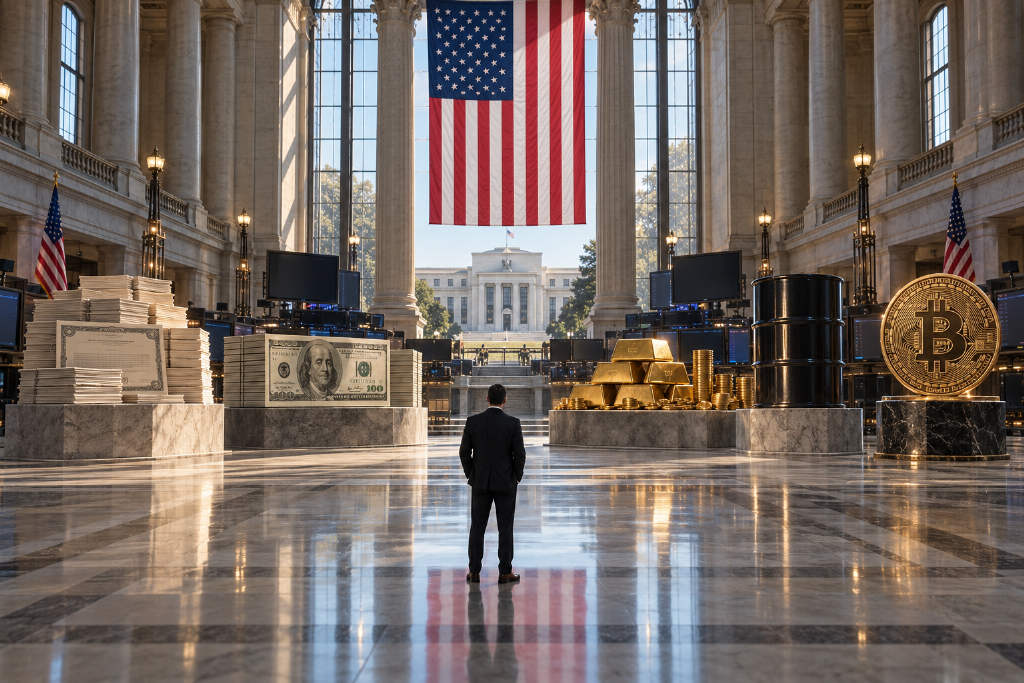
Bitcoin2026-10-26 07:56:55How the Dollar and Treasuries Shape Bitcoin, Gold, Oil and U.S. StocksBlockTempo mapped out the links between six markets that are often treated separately: the U.S. dollar, U.S. Treasuries, U.S. equities, gold, oil and Bitcoin. The piece argues that the clearest way to read cross-asset moves is not to memorize price screens, but to track three questions: how expensive money is, whether the dollar is strengthening or weakening, and how much risk investors are willing to take. In that framework, the dollar remains the core unit for trade, commodity pricing and reserves, while Treasury yields function as a practical benchmark for so-called risk-free rates. Changes in rates and dollar strength then feed into equity valuations, the opportunity cost of holding gold, and the pricing environment for oil. Bitcoin sits in a more complicated position. Its fixed issuance schedule and eventual supply cap of about 21 million coins support the “digital gold” narrative, yet its trading behavior often lines up with high-beta risk assets, especially during swings in liquidity and tech-stock sentiment. The article also notes that older BlockTempo-cited data showed the share of Bitcoin returns explained by the U.S. Dollar Index could fall to about 17%, suggesting DXY alone is not enough to explain crypto moves.220
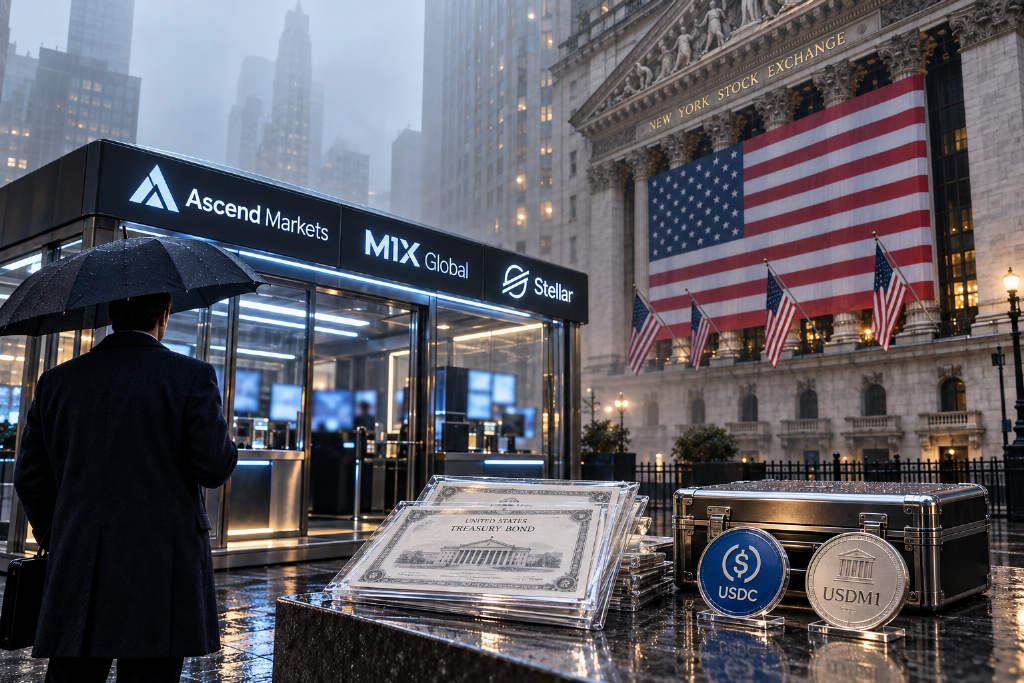
Policy and Re2026-10-23 16:51:12Ascend Markets and M1X Global complete regulated repo transaction on StellarAscend Markets and the M1X Global platform said on Oct. 23 Beijing time that they had completed what they described as the first regulated short-term collateralized lending, or repurchase agreement, transaction on the Stellar blockchain. The pilot involved digitized U.S. Treasuries used in interbank settlement and was presented as a precedent for direct collateral movement without participation from a central clearing system. The transaction used USDM1 bonds backed by U.S. Treasuries as collateral and settled in the USDC stablecoin. Pricing was fixed at SOFR plus 10 basis points, equivalent to an annualized rate of 3.98%. From Oct. 16 to Oct. 19, including the weekend, an algorithm carried out 72 consecutive hourly rollovers over a 72-hour period, handling collateral lockup, interest calculation, and settlement. Total network fees across all cycles came in at less than $0.01. Data from rwa.xyz showed that the value of real-world assets on Stellar had reached $3.64 billion by the end of October 2026.300
AI2026-10-23 13:19:20AI debt concerns drive flight to safety as 10-year Treasury yield slips below 5%Techub, citing CNBC, reported that investor concern over artificial intelligence spending hit equities this week and sent money into safer assets, pulling the 10-year U.S. Treasury yield back below 5%. The move came as markets grew uneasy about the large debt loads technology companies are taking on to build AI networks. That pressure weighed on tech stocks, pushed up yields on tech company bonds, and widened credit default swap spreads for several AI companies. By Friday, benchmark Treasury yields had edged higher on the day, with the 10-year note up 1 basis point to 4.966% and the 2-year yield up 2 basis points to 4.658%, while the 30-year yield was little changed at 5.292%. The report frames the week’s Treasury move as part of a broader risk-off shift tied to concerns around AI-related financing and its effect on the technology sector.260